How Energy, Transport & Tech Are Reshaping UAE Property Demand in 2026
The UAE property market enters 2026 from a position of resilience rather than hype. Transaction activity remains healthy, capital inflows are steady, and population growth continues to underpin demand. What has changed is why demand is forming—and where it is concentrating.
The next phase of UAE real estate will not be defined by short-term launches or speculative momentum. Pricing performance, absorption rates, and location premiums are increasingly influenced by energy investment, transportation connectivity, and technology-driven economic growth.
These forces are not acting in isolation. Together, they are creating new value corridors, reshaping live–work preferences, and directing capital toward assets that align with long-term infrastructure and employment patterns.
What Will Shape UAE Property Prices in 2026?
The UAE property market is now more selective than ever with its pricing. Instead of general appreciation, the value rise is limited to areas where job creation, mobility, and infrastructure investment occur simultaneously. The gigantic scale of construction was an early telltale sign. In fact, the overall figure of contracts given out in the early part of the approaching 2025 was Dh143 billion, and it was primarily made up of new energy systems, transport infrastructure, and logistics expansion, along with digital assets. All these investments are closely interconnected with the real estate cycle—they are directly affecting residential demand, commercial leasing, and land valuations. Building and construction activities signal the transition from isolated property cycles to infrastructure-led urban growth, where the real estate market gradually mirrors long-term economic planning rather than short-term sentiment.
Energy Investment Is Quietly Reshaping Where People Live
Clean and transitional energy has emerged as one of the most understated drivers of real estate demand in the UAE.
Under the UAE Energy Strategy 2050, clean energy is expected to account for close to 50% of the national energy mix, supported by projected investments of up to Dh600 billion over the coming decades. The real estate impact extends far beyond power generation itself.
Large-scale solar parks, hydrogen projects, grid upgrades, and energy storage facilities require:
- Skilled and semi-skilled workforces
- Logistics and operational support
- Long-term housing close to employment nodes
Over time, this creates residential and mixed-use demand in areas previously viewed as peripheral or purely industrial. In Dubai, the push toward 75% renewable electricity by 2050 is reinforcing similar patterns at an emirate level.
Rather than pushing prices up everywhere, energy investment is concentrating value in specific corridors where infrastructure, employment, and housing align.
Transport Infrastructure Is Pulling Land Values Tight, Besides Giving Access
Transportation investments have always played a part in setting property prices, but it is the UAE where their impact is growing to be the most important one.
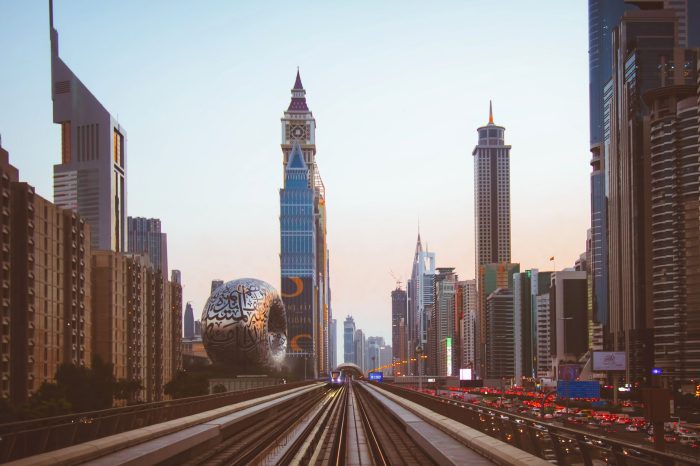
There are metro extensions, road paving, freight corridors, and rail being built that are changing the area of the city regarded as the prime one. Areas previously rated as secondary are being priced in accordance with connectivity, not the other way round, as soon as connectivity becomes measurable and not theoretical.
Examples of such projects include:
- The Dubai Metro Blue Line
- Strategic Road Network upgrades
- Etihad Rail, connecting all seven emirates
These developments are influencing buyer preferences even before the works are completed. Buyers and investors are more and more basing their asset prices on future accessibility rather than just current travel times.
All this is causing a more intensive demand for land around stations, transport hubs, and interchanges, which is in turn fostering long-term value retention rather than a short-lived appreciation spike.

Technology and AI Are Changing the Composition of Property Demand
The aspiration of the UAE to be the world leader in technology, AI, and digital infrastructure is making a big impact on the demand for commercial real estate.
The following sectors are pushing the demand higher:
- Data centres
- Innovation districts
- Tech-linked industrial zones
- Knowledge-based office clusters
The tech hubs are seeking the assets that have longer leasing terms, higher technical specifications, and more stabilized occupancies.
Consequently, the demand is shifting from the usual office spaces to the specially designed facilities that cater to the digital opera, research, and specialized talent. The housing demand is linked to the job supply, and thus, it is reinforcing the mixed-use urban ecosystems and not isolated developments.
Mixed-Use Communities Transitioning From Concept to Default
By 2026, mixed-use development is not just an urban planning trend in the UAE—it is becoming the standard practice.
National sustainability objectives, the promotion of work-life balance, and the quest for more efficient infrastructure are all leading to the integration of urban environments. More and more, new projects are putting together the residential, commercial, retail, and lifestyle components in one whole and compact forming a city.
This is a definite turn away from:
- Standalone residential compounds
- Single-use business districts
and it is thus a shift toward connected communities that are designed according to proximity, access, and long-term livability.
For property values, the implication is very simple: developments that promote less commuting and enable easier access to daily needs are experiencing greater end-user demand and more stable investor interest.
Why Dubai’s Construction Cost Advantage Still Matters
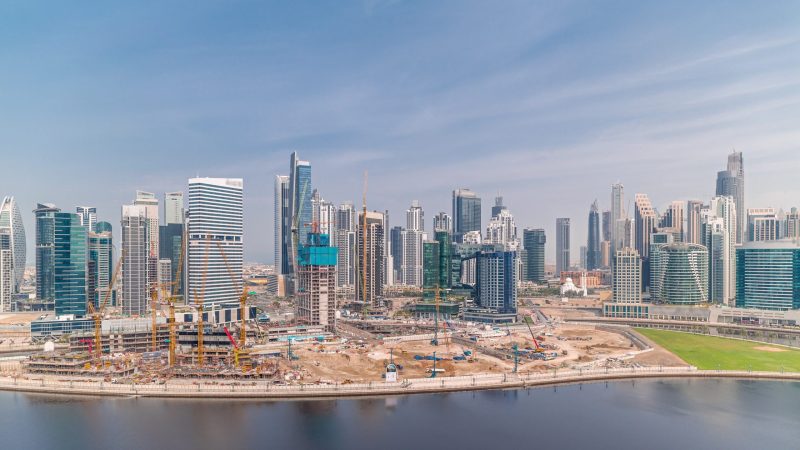
Despite rising global input costs, Dubai remains one of the most cost-efficient construction markets among major international cities.
Scale, integrated supply chains, and predictable regulatory frameworks continue to support competitive delivery, particularly in:
- Mid-market residential projects
- Logistics and industrial assets
- Infrastructure-linked developments
While labour and material costs are expected to rise modestly through 2026, industry participants do not expect Dubai’s structural cost advantage to disappear.
Pressure is more evident at the premium end of the market, where sustainability standards, smart-building systems, and energy-efficiency requirements raise upfront costs. However, these assets are also showing stronger tenant demand and greater long-term resilience.
Digital Construction Is Reducing Risk, Not Just Cost
Technology is also reshaping how projects are planned, tendered, and delivered across the UAE.
The growing use of:
- Building Information Modelling (BIM)
- AI-assisted design and planning
- Real-time site monitoring
is shifting procurement decisions away from lowest price toward execution certainty.
For investors and developers, this translates into fewer delays, reduced rework, and more predictable delivery timelines. Digital capability is fast becoming a baseline requirement for large-scale projects, supporting more stable returns across development cycles.
Non-Oil Economic Growth Is Reinforcing Long-Term Housing Demand
The UAE’s non-oil economy now accounts for more than 75% of GDP, and this diversification continues to feed directly into real estate demand.
Growth in financial services, tourism, trade, and professional sectors is attracting residents who are more inclined toward longer-term housing within integrated communities. The expansion of regional headquarters by multinational firms is reinforcing demand for residential, office, and lifestyle assets within the same developments.
This shift is helping reduce reliance on cyclical demand drivers and supporting steadier absorption across both residential and commercial segments.
Infrastructure Is Creating New Investment Corridors
Infrastructure spending is no longer just supporting established urban centres—it is actively creating new property corridors.
Connectivity is now viewed as a baseline requirement rather than an added benefit. Areas linked to metro lines, national rail, and logistics networks are attracting earlier investor interest as buyers factor in long-term accessibility and employment growth.
Communities near transport and logistics nodes are increasingly emerging as hybrid residential-commercial clusters, particularly outside traditional core districts.
Cost Pressure and the Skills Challenge
Rising labour and material costs remain a factor, but developers are responding through:
- Earlier design optimisation
- Modular construction techniques
- Strategic procurement planning
A more pressing challenge is the availability of skilled contractors and technical expertise. Upskilling and digital training are becoming critical to maintaining delivery timelines and asset quality.
Developers who integrate construction, operations, and facilities management earlier in the project lifecycle are reporting fewer handover issues and stronger long-term performance.
What to Watch in UAE Real Estate in 2026
As the market moves deeper into 2026, several themes are becoming clear:
- Energy investment is reshaping residential and mixed-use demand
- Transport connectivity is redefining future pricing benchmarks
- Technology and non-oil growth are stabilising commercial real estate yields
- Mixed-use developments are becoming the dominant urban model
Rather than rewarding short-term cycles, the UAE property market is increasingly favouring alignment with infrastructure, employment, and long-term economic strategy. For investors and end-users alike, understanding where these forces overlap will be central to navigating the market in the years ahead.